

Authentic Bedouin Desert Experiences in El Gouna & Hurghada. Jeep safaris, Sunset hikes, climbing, stargazing, yoga, Bedouin dinners and raw desert exploration in the Red Sea mountains of Egypt.


Everything You Need to Know About our Desert Experiences
in El Gouna & Hurghada:
-How much does the the 'Sunset Experience Trip' cost?
-From what time to what time does the 'Sunset Experience Trip' last?
-What should we bring for ourselves to the trip?
-The 'Dinner under the Stars'. What does that dinner entail?
-Cancellation policy.
and more...
Some background information about our 'Trips':
-Wadi Bileh, the Dry Canyon, Hidden Desert Nature Near El Gouna.
-Jebena (Gebena) Coffee Ceremony. Authentic Bedouin Coffee Experience.
-Meet Our Ababda Bedouin Team. Local Knowledge & Desert Traditions.
-Fennec Fox in the Egyptian Desert. Sahara Wildlife Experience.
and more...
How much does the 'Sunset Experience Trip' cost and when is it paid?
-The price for a 'Sunset Trip' is €55 or equivalent amount in egp.
(there is a discount for children <10y, residents and Egyptians).
Payment is made upon departure to the desert. (Bank card payments are available).
-Prices 'Special Trips' on request.
Where and how is the start of the 'Sunset Experience Trip'?
-The meeting point is at the 'Sharqi/Caleo restaurant' and the 'Karibu bar & restaurant'.
(El Gouna downtown, opposite Go Bus office).
-We start from there with safari jeep(s) in the direction of the desert/ Wadi Bileh.
-Chat with us to discuss pick-up options in and around El Gouna.
From what time to what time does the 'Sunset Experience Trip' last?
-Normally we gather around 3:00pm and we are back in El Gouna at 9:00pm
(during the winter months).
-During the summer months we leave at a later time (4:00 p.m.) because of the late sunset.
Is it possible to go to the desert during the summer months?
- Absolutely. The desert trips with us continue during the summer months. In fact, we specifically adjust the schedule to 4 p.m. for the heat and later sunset. We also stay in the shade provided by Wadi Billeh during the hottest moments of the trip, which makes the temperatures much more manageable.
The focus during summer is on enjoying the cooler late afternoon and evening atmosphere of the desert. The beautiful sunset light, mountain views, silence, and clear skies. It’s a completely different feeling from the city heat, and honestly one of the most magical times to experience the desert.
What should we bring for ourselves to the trip?
-Certainly a small bottle of drinking water. Easy walking shoes or light hiking boots. Wear comfortable clothes and for the rest something warm to put on after sunset during the winter months. (Extra refills drinking water is provided by us).
-How to create eco-conscious desert experience with minimal environmental impact?
-We believe the desert should be discovered with respect and left exactly as we found it.
Our trips are designed around small groups, minimal environmental impact, and a conscious connection with nature.
We actively encourage guests to leave no trace by using refillable water bottles, avoiding unnecessary packaging, and respecting the fragile desert ecosystem at all times. Cigarette butts, plastic waste, and disposable materials are among the most common forms of pollution in the Red Sea desert, while even the smallest piece of waste can remain in nature for decades.
By consciously choosing sustainable alternatives and traveling responsibly together, we help preserve the silence, purity, and beauty of the mountains and wadis around El Gouna for future generations.
Are the mountain goats only intended for people who are in El Gouna?
-Everyone is welcome with us. Gounies as well as people from outside El Gouna,
Egyptians and non-Egyptians.
Only 30 minutes from Hurghada and easily accessible from Makadi Bay, Sahl Hasheesh and Soma Bay.
Can children join?
-Yes, depending on the trip.
Some, like the 'sunset experience' are family friendly, while longer mountain hikes are better suited for older children or adults.
Is it safe to go to the desert?
-Yes. Safety is one of the top priorities during all our desert experiences. Our trips are guided by experienced guides who know the mountains, valleys, and desert routes extremely well.
Before every trip, there will be a short safety briefing by the guide to explain the route, the activities, and important desert safety guidelines. This helps everyone feel comfortable, prepared, and ready to enjoy the adventure. We carefully plan every tour and adapt the experience to the group’s fitness level and comfort. Whether you join a sunset trip, hiking adventure, or full-day expedition, you will always be guided and supported throughout the journey.
At the end of the 'Sunset Experience Trip', there is a 'Dinner under the Stars'. What does that dinner entail?
-The Sunset Experience concludes with an atmospheric Dinner under the Stars. In the middle of the desert, we serve a freshly prepared dinner. The typical Bedouin menu includes: Rice, Mesaka’a, Marinated grilled chicken, Tahini, Flat baladi bread, Fresh vegetables and Fruit. Vegan-friendly if you skip the grill and Gluten-free. Bon appétit !!!
Why is El Gouna Mountain Goats called Mountain Goats?
-Because the trips are about going further than just the desert. Exploring difficult terrain and experiencing freedom outdoors. A bit like mountain goats themselves.
It also reflects the adventure and spirit behind the project.
Can I book custom experiences?
-Yes!!! Custom trips can include: Photography focused adventures; Stargazing; Sunrise hikes; Full-day mountain expeditions; Historical exploration; Private groups; Special occasions;...
What about taking photos?
-During a trip, photos may be taken by the mountain goats team as well as by other hikers. Participants consent to the use of their images for promotional purposes and publication on social media, unless otherwise specified by them.
Cancellation policy:
Some background information about our 'Trips':
Wadi Bileh (Billi, Bili, Billy, Belli) the Dry Canyon, Hidden Desert Nature Near El Gouna:
(Google Maps Location)
-Most of our 'Trips' take place in Wadi Bileh and the surrounding area. Wadi Bileh, once a river that carved its way through a fossilized seabed is now a dry canyon, valley or ravine. In case of exceptionally heavy rainfall, it can happen that its becomes a watercourse. It takes its name from an old Arab tribe, the Bileh, who arrived in Egypt from Saudi Arabia after the Islamic Conquest.
Prior to the Muslim conquest of Egypt, Egypt was under Greek and Roman influence.
After the conquest Arabic became the official language in Egypt rather than Coptic or Greek.The Caliphate encouraged the migration of Arab tribes to Egypt.The Muslim governor of Egypt encouraged the migration of tribes from the Arabian Peninsula to Egypt to increase the Muslim population in the region and to strengthen his regime by enlisting warrior tribesmen to his forces, encouraging them to bring their families and entire clans. The Fatimid era was the peak of Bedouin Arab tribal migrations to Egypt.
Explore Wadi Bileh yourself during our Sunset Experience.


Wadi Bileh, Flash Flood El Gouna 2014:
The Eastern Desert of Egypt is one of the driest regions in the world. Rainfall is rare, but
when it does occur, it can be extremely intense and lead to dangerous flash floods.
These sudden floods sometimes cause major damage to infrastructure, homes, roads, and vehicles, but at the same time they also represent an important natural source of fresh water
in a region where water scarcity and extreme evaporation are part of daily reality.
Well-known examples of such extreme weather events are the severe floods in Wadi Bileh
and El Gouna in March 2014, and later in Ras Gharib in October 2016. During the floods in
Ras Gharib, at least nine people lost their lives and dozens of others were injured. Roads, houses, and infrastructure suffered extensive damage.
On March 9, 2014, Wadi Bileh was struck by an exceptional storm. Rainwater rushed down from the mountains of the Eastern Desert through the canyon toward the Red Sea, causing damage as far away as El Gouna.
What made this event so remarkable was not only the amount of rainfall, but especially the immense force with which a dry wadi suddenly came back to life. The dry riverbeds once
again functioned as they had thousands of years ago: as natural waterways transporting enormous amounts of water toward the coast within a very short time.
In early March 2014, there had already been several light rain showers, particularly around March 3. However, the atmosphere remained unstable, and on March 8 and 9 thick grey thunderclouds formed above El Gouna, accompanied by intense lightning and thunder. The heavy rainfall that followed caused severe flash floods in several wadis of the Eastern Desert.
For people familiar with the region, especially around Wadi Billeh, such events create a deep respect for the landscape. The wide gravel plains, eroded canyons, and natural passages in
the desert were shaped by exactly these kinds of floods. But over thousands of years.
At the same time, these events demonstrate how dangerous a flash flood in Egypt’s Eastern Desert can be. Even when the coast remains completely dry, an enormous mass of water can form dozens of kilometers inland and move with tremendous force through the wadis toward
the sea.
This is why local knowledge, especially that of the Bedouins who know this desert landscape and its wadis so well remains invaluable.

Flash Flood 2014

Flash Flood 2014

Flash Flood 2014
Flash Flood 2014
A Palaeolithic (Old Stone Age) site at Wadi Billeh:
-During its field campaign of 2003, the Belgian Middle Egypt Prehistoric Project of Leuven University and the Royal Belgian Institute of Natural Sciences set out to test a small cave in the Red Sea Mountains west of El Gouna near Hurghada and the wider area around this cave.
Wadi Billeh is a wadi draining the Red Sea Mountains. It finds it way to the Red Sea through a deeply incised gorge in the Abu Sha'ar Plateau west of El Gouna. The hill culminating at an elevation of 200 m, forms a cuesta of which the front is facing the Red Sea coastal plain. The hill consists of black basement rocks with a cover of brown-yellow Eocene sandy limestone.
Approximately 40 bone fragments were found which mainly belonged to large animals in the
size range of large bovids (buffalo, aurochs, kudu). In addition, a few long bone fragments in the size range of medium-sized herbivores (dorcas gazelle, ibex or Barbary sheep) were present.
West of the hill a large flat pediment at an elevation of 140-100 m drains the area towards the gorge. Where the wadi enters its gorge a dune tends to block the entrance of the gorge. In its present state the dune has been breached by the wadi, but presume that, during the very dry periods of the Last Ice Age, the dune was able to block entirely the run off waters of the wadi. If this happened, a lake could be created in the upper parts of the Wadi Billeh basin. Severe erosion, aeolian as well as run off is probably responsible for this situation.
Gradually cleaning the desert pavement by the university team, 497 large artefacts occurred in the underlying loose sand. Lithic artefacts such as the flint, are clearly imported and mostly of excellent quality. Cortical flakes are also well represented.
(reference: Journal of African Archaeology)


Jebena (Gebena) Coffee Ceremony in El Gouna. Authentic Bedouin Coffee Experience:
-Apart from strong black sugar rich tea, the Ababda tribe to which our Bedouin team belongs
most common social drink is ‘Jebena’, or hand roasted coffee beans, that are ground with
ginger and poured into a round earthen jar with a long neck.
With added water the jar is placed between the glowing embers of the fire to boil, and the
coffee successively served with loads of sugar in small porcelain cups.
The minimum number of rounds to drink is three or if you drink more, you must end up with
an odd number.
These three rounds are known as Abol, Tona, and Baraka.
Abol, the first round, is the strongest and most robust brew, marking the formal beginning of the ceremony.
The second round, Tona, is slightly milder and symbolises the strengthening of bonds and conversation among guests.
The final round, Baraka, often called the blessing cup, is the lightest and represents goodwill, gratitude, and spiritual blessing.
Sugar is usually offered before the first round, depending on personal preference.
If a guest doesn't drink their cup right away, its becomes the “cup of the sword.” This means the guest has come with a matter of urgencies, such as marriage or warfare, and he won't drink
the coffee until the request is met. So be careful!!!
For our guests during a desert trip with us, taking part in the ceremony is considered an honour rather than a performance, reflecting the warmth, authenticity, and generosity of true Ababda Bedouin hospitality.
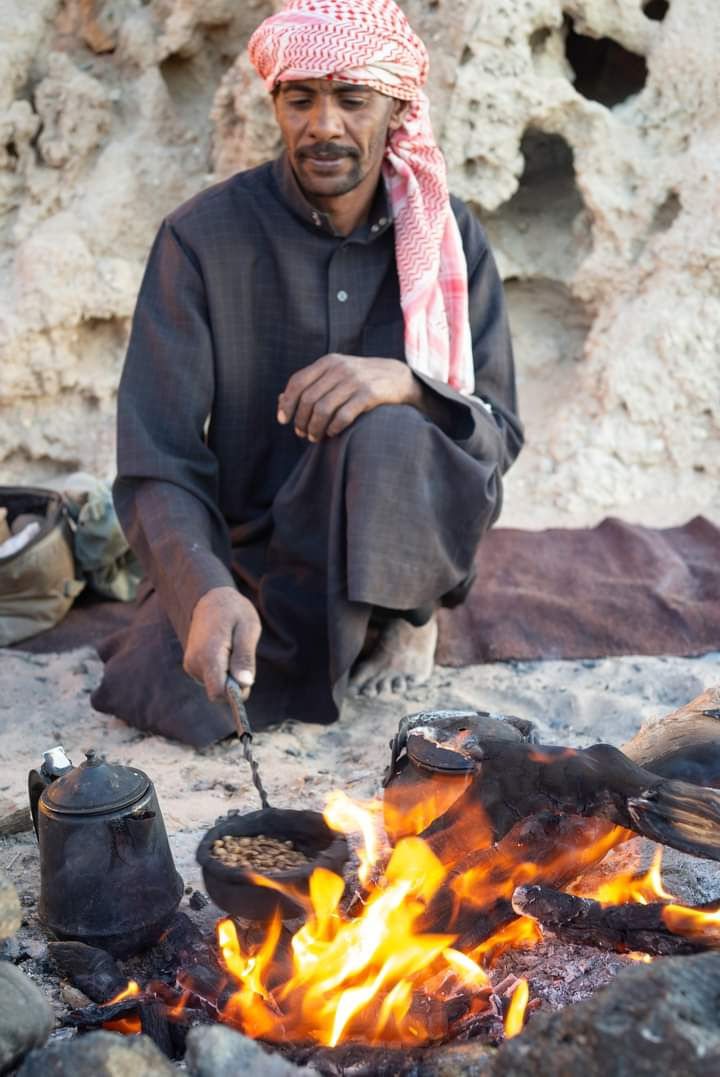


Meet Our Ababda Bedouin Team. Local Knowledge & Desert Traditions:
-The Red Sea Mountains are a chain of rugged peaks running the length of Egypt's Red Sea coastline. Every part of these mountains are controlled by Bedouin tribes or clans. The Ababda, Ma'aza and Bishari are found in the region today and each tribe has its own territory.
The territory of the Ababda tribe extends in the area between the Nile and the Red Sea,
mainly south of the town of Al-Quseir to Aswan.
The tribe is also strongly represented in Sudan and Eritrea. The total population is estimated
at 250,000 of which 83,000 are in Egypt.
The Ababda are one of the most important and oldest tribes in Egypt. They lived for generations trading camel, herding livestock and gathering medicinal herbs, while also using their tracking skills to help the Armed Forces. Gold mining was also one of their traditional skills. Members of the Ababda tribe are not looking for wealth, rather, like anyone else, they seek a stable life while preserving their traditions.
Today, many Ababda families no longer live exclusively in the desert.
The grandfather of Hamada (founder mountaingoats), Sheikh and a member of the Ababda tribe, settled here in Hurghada decades ago at a water source near what has now become
El Gouna. There are currently about 90 Bedouins from the Ababda tribe in this area.
In exchange for water, they received electricity from the developing El Gouna.
For the moment they are involved in, for example, the security of El Gouna, which provided
a fixed income for many.
It's always a little bit of National Geographic Live if they give a small demonstration of the Ababda's adaption to the desert that has moulded their lives and shaped their identity,
habits and traditions.
For example their welcome drink, the fabulous Jebena coffee.
Also the way of making bread. Making this bread does not require ovens, gas or electricity,
nor does it need pots. The dough is made of flour, water and salt and does not require fermentation. Wood is burned into embers while heating the sand below. As the embers are
set aside, they dig a hole in the hot sand, similar to the chamber of an oven. Cover the dough with sand before placing the embers back on top. After half an hour, the bread will be
removed from the hole and cleaned from sand and ember.
The name of the bread is Qaburi.
-On February 14, 2021, we received the sad news that Sheikh Ahmed Mansour Al-Abbadi passed away at the age of 98. He will always be remembered as a man of great poise and dignity, father of the tribe and guardian of the land.
Hamada, the eldest grandson has become the worthy successor as Sheikh after the death
of his grandfather.


The Ma’aza Tribe in the Eastern Desert of Egypt. Bedouin Heritage:
-After the Islamic conquest and tribes coming from Saudi Arabia, the Ababda tribe was the most important tribe in Egypt. Until about 250 years ago, Ma'aza tribes also began to emigrate from northwest Saoudi Arabia to the eastern desert. Fighting the resident Ababda forced the Ababda south to a smaller area in the eastern desert.
Since then, the Ma'aza Bedouin tribe, comprising about twenty subgroups of patrilineal clans, has made its homeland in roughly the northern half of Egypt's eastern desert, between the Nile Valley and the Red Sea. The total tribal area is about 102,000 square kilometers.
The Egyptian authorities do not formally recognize these Bedouin homelands and these areas are simply defined as sovereign Egyptian land.
To a tourist unfamiliar with a desert used by nomadic herders, large areas of the eastern desert may appear dry wasteland or pristine desert wilderness. More precisely, it is a cultural landscape shaped by the preferences and activities of the Bedouin over a period of many generations.
The Bedouin rely on oral tradition to perpetuate knowl
Human life in this wilderness requires a rich knowledge of places. Functionally, places are among the resources that support Bedouin life in the desert (water sources are the best example) and serve as landmarks that lead to resources. Where landmarks are missing or misread, tragedy can ensue: many places are named after people who died of thirst.
Most graves are also located near water. Nothing to do with dying of thirst but with Islamic
law and tribal custom that prescribes that the body of the deceased must be washed and
buried on the day of death, but this is not always possible. Numerous places are named for those buried in less than ideal conditions.
Some Bedouins, like our driver Salama from the Khushmaan Ma'aza tribe, have a lot of
desert experience and can give an impromptu lesson about typical Bedouins ecological associations.The Ma'aza pastoralist developed a conservation system with redundant mechanisms protecting the trees. One vital measure was simple naming the trees.
The named tree is important on a number of levels: it serves as a living way-finding landmark. To cut down a named tree would be to remove a way-finding landmark that could mean
life or death in a desert crossing.
Even the characteristic well-groomed shape of the acacia tree results from careful tending
by herders and their monitoring of camel and goat browsing.
Some people think that Bedouin are rootless, placeless wanderers who overuse the resources of the commons. Bedouin are invested in knowing them, identifying themselves with them
and using their resources carefully to perpetuate their way of life.
Most Khushmaan Ma'aza were pastoral nomads tending sheep, goats and camels and employing typical patterns of movement to take advantage of ephemeral pastures.
Men worked intermittently in, and did the family shopping and trading with, communities of
the Nile Valley and Red Sea coasts. Since then they have been settling down, and very few
Ma'aza families now practice nomadic pastoralism. Their responses to the economic opportunities posed by tourism, have been the main factors behind this major socio-economic change. Young people would not have incentives to experience and learn about their desert anymore. Unless young people learn their environment, there will soon be no Bedouin life in their homeland.
If you would ask Salama 'How do places get their names?'. He will properly answered with
this scenario: If you spent ten days of a month in a little wadi and people came and went
and saw you there, they would call it Shi'b al-Khawaaja, the 'Wadi of the Foreigner'.
The primary objects of Ma'aza place-naming are valleys and other drainages and flatlands, followed by jebels (mountains) and other kinds of rocky promontories and elevations, water sources, trees and shrubs, and routes and trails.
After drainages, the second most commonly named landscape features are rocky high places and rocks. The Ma'aza homeland is mainly stony rather than sandy. Rock, ridge, promontory,
hill and mountain types range from boulders to mainland Egypt's highest mountain Jebel Shaayib al-Banaat (2,187m).


Ma'aza tribe at Wadi Billeh El Gouna Mountain Goats
The Oud – The Heart of Bedouin Music
The oud (Arabic: العود – al-ʿūd) has been played for more than 2,000 years and is one of the oldest and most cherished twelve-stringed instruments of the Arab world. Widely regarded as the predecessor of the European lute, it has formed the musical heart of both classical Arabic music and traditional Bedouin music for centuries.
Its fretless neck allows the musician to perform the distinctive Arabic musical modes (maqamat), including the subtle quarter tones that give Arabic music its unique warmth, depth, and emotional character. The oud is played with a long plectrum, known as a risha, capable of producing both gentle, meditative melodies and dazzling virtuoso improvisations.
Among the Bedouins, the oud holds a special place. It is far more than a musical instrument.
It tells stories, preserves traditions, and expresses emotions that often require no words.
Its melodies are typically calm and repetitive, blending seamlessly with the silence and vastness of the desert.
Our guide and musician, Hassan, beautifully demonstrates the expressive power of the oud. Without singing a single word, his playing conveys emotions, memories, and the very soul of the desert.
A high-quality handmade Egyptian oud is typically crafted from a carefully selected combination of woods such as walnut, maple, and rosewood, with a soundboard made from cedar or spruce. Because each type of wood resonates differently, every oud possesses its own unique tonal character.
During our desert experiences, gathered around the Bedouin campfire in the heart of Egypt's Eastern Desert, the music of the oud takes on an even deeper meaning. Accompanied by the rhythmic hand clapping of Sheikh Hamada and Bedouin guides Khaled, Karim, and Ahmed, together with the steady beat of the tabla (traditional drum), played by our jeep safari
driver Jaan, an authentic atmosphere comes to life where music, storytelling, and Bedouin hospitality become one.
The combination of the oud's warm, resonant sound, the rhythm of the tabla, the crackling campfire, and the profound silence of the desert makes this finale one of the most unforgettable moments of many guests' stay in Egypt. It is an experience that brings the richness of Bedouin culture to life and lingers in the memory long after the journey has ended.


Fennec Fox in the Egyptian Desert. Sahara Wildlife Experience:
-Our 'Sunset Experience Trip' isn't complete if we didn't share our dinner with our friends the Fennec, the Egyptian desert fox (scientific name: Vulpes zerda).
The fennec is the smallest fox species. Its coat, ears, and kidney functions have adapted to the desert environment with high temperatures and little water. The fennec has a life span of up to 10 years in the wild.
It has large ears. Not only does its ears helpt it hear steps and oscillations while hunting, but they also help him to keep cool. This is due to the dilation of the blood vessels in his ears. The blood inside these vessels cools and then flows through the circulatory system inside his body, which lowers his temperature, with the temperature rising in the desert.
These animals are omnivores, eating mostly insects, small mammals, birds, leaves, roots, and fruits. They can also eat rodents, eggs and small reptiles. Fennec foxes can go for an indefinite period of time without water, as most of the water they need is provided by the plants and animals they eat. These periods without water may extend to years, but it will drink if a source of water is available
Its weight does not exceed 1.5 kilograms, its height at the shoulders is 20 centimetres, its body length is about 40 centimetres, its tail is about 25 centimetres, and the ears can be up to 15 centimetres long. The colour of the fennec is usually sandy, which helps it camouflage in its desert surroundings.
These foxes have thick fur on the soles of their legs to protect them from the burning sand while they move.
Males are expelled from the group as soon as they reach puberty, unless one of them manages to defeat the main male and replace him in controlling the harem, and the battles between males are very violent, but they are rarely fatal.
When males leave their family, they roam the desert in search of another harem to fight the dominant male and replace him, or search for other groups that need secondary males. These males are usually not allowed to reproduce during the mating season.
Fennec foxes are legally protected in Egypt.
-Watch your personal stuff when they come to visit us. Not only are they out for food. But apparently they can also use shoes and so...


'Desert Breath' Land Art Installation, another hidden gem of El Gouna:
-Near El Gouna lies one of the desert’s strangest and most fascinating landmarks: Desert Breath. A hidden gem in the Egyptian desert that almost feels unreal when you first see it.
You’ll often come across photos of it on websites discussing UFOs or extraterrestrial theories because of its surreal appearance. But the story behind it is very different. Desert Breath is a massive 100,000 m² land artwork created in 1997 by the D.A.ST. Arteam in collaboration with Orascom Development, the company behind El Gouna. At the time, it also served as a bold artistic statement and a way to put El Gouna on the map.
The artwork was designed to slowly disappear over time. Subject to natural erosion, the spirals and cones gradually blend back into the desert landscape. Yet even today, Desert Breath remains clearly visible from the ground and especially from above. In many ways, the gradual return of the desert to its original form was part of the artwork’s intention from the beginning.
If you’re travelling with us towards Wadi Billeh, it’s possible to make a short stop along the way to experience this extraordinary piece of desert art with your own eyes.


